Showing posts with label Scripture. Show all posts

Saturday, September 21, 2024

BEFORE I GO: Some Final Instructions, Part 3–KEEP TRUE


America is in a perilous position. The nation has faced many assaults in the past. Growing government tyranny and the attack on cherished freedoms such as freedom of religion, freedom of speech, freedom of assembly, and the right to bear arms, along with the decline of our economy and open borders—while embracing the butchering of babies in the womb and parading of perversion in the streets is horrifying.  I commented recently to a lady who mentioned this that, it is “national suicide!”  

The church is no longer looked upon as a benefit to society, but an enemy. How will the church respond to living in an antagonistic world?  The choice of many churches is to cave to the culture by compromise. At first they grow quiet while still claiming to maintain their convictions. Yet, it is only a matter of time until such churches take the next step away from the faith. 

That is a bleak picture, and mirrors the one Paul paints here. The encouragement is that the church in its infancy grew and flourished in a pagan culture where they were hated and hurt.  So, may we.  

Jesus promised that His church would march to victory and the gates of hell would not be able to withstand her. Paul was in bonds, but the Gospel was not bound (2:9). He was leading prison guards and prisoners to faith, and some of those soldiers would wind up as Imperial guards and witnesses to those of Caesar’s household!  He was penning powerful words that are still changing lives today. 

There are foes we must face and a weapon we must wield as we examine 2 Timothy 3.

First, we will consider THE FOES WE MUST FACE (v.1-9). The Apostle warns that difficult times are coming. I believe they are right around the corner. I pray I am wrong, but I am persuaded that I am right. We face a foe that is mostly overt and one that is more covert. 

One foe we face is the hostility of the world (v.1-5). Watch the news on TV.  Go out into public. What Paul describes here might as well be America in the 21st century. 

Rather than loving people and using money, we will love money and use people as “lovers of self” and “lovers of money” (v. 2a).  Arrogance will be apparent as mankind is “proud” and “abusive,” (v. 2b). 

There is disrespect of authority, beginning in the home, “disobedient to parents,” (v. 2c), and defiance at home breeds disregard of heaven, “ungrateful, unholy...” (v. 2d)—rejecting our earthly fathers translating into rejection of the Eternal Father. Then follows despising His rule and throwing off moral restraint (v.3-5). Religion will be present, but an empty shell—mere ritual with deadening effect. 

This leads from the hostility of the world, which is overt, to that which is covert—the subtlety of the wayward (v.6-9). The devil manifests himself at times as a roaring lion seeking to strike fear into his prey.  On other occasions, he is a sneaky snake that crawls in and waits in the darkness before injecting its deadly venom of sin into the victim. This is how the serpent attacked Eve—first to doubt the accuracy of the Word of God with a question, “Did God actually say?” (Gen. 3:1) and then to deny the authority of the Word of God with a contradiction, “You will not surely die,” (Gen. 3:4).

The Devil uses creeps—“those who creep into households and capture weak women,” (v. 6a). They creep in on a podcast, a popular book, and so forth. If discernment is not exercised, they will be, “ever learning and never able to arrive at a knowledge of the truth,” (v. 7).  

The Apostle had previously warned, 

“Let a woman learn quietly with all submissiveness. I do not permit a woman to teach or to exercise authority over a man; rather, she is to remain quiet. For Adam was formed first, then Eve; and Adam was not deceived, but the woman was deceived and became a transgressor. Yet she will be saved through childbearing—if they continue in faith and love and holiness, with self-control.” (1 Tim.2:11-15). 

The culture is increasingly feminized—masculinity is under attack as “toxic”—and this spirit is growing in the church in the name of equality. Of course, there is equality of dignity among men and women!  Neither sex is to be valued above the other. Yet, while there is no difference in dignity and worth, there is a difference in duty and work. We have different roles. 

The elders of the church are to be men who are the gatekeepers of sound doctrine while the women are to be the homemakers of young disciples. Timothy’s faith had been birthed and built due to the effort of his godly mother and grandmother, (cf. 2 Tim. 1:5). Women have a different role in the church and men have a different role in the home—neither less essential, but not identical.  

Beware of counterfeits like Jannes and Jambres who opposed Moses with their fake miracles, (v. 8-9). They really didn’t seem that different on the surface, but at the heart it was the distance between heaven and hell. They learn it in a liberal seminary and export it to the local sanctuary. Little by little, they inject the serpent’s venom into the church with deadening effect.

How can we endure the hostility of the world and overcome the subtlety of the wayward?  There is THE WEAPON WE MUST WIELD (v.10-17). The Sword of the Spirit is the Word of God.  This is how Jesus conquered Satan, and so must we with, “It is written!”  

This mighty weapon must be wielded with endurance (v.10-15). Paul stresses endurance in v.10, 11, and the need to “continue in what you have learned and have firmly believed” (v.14). This is my call to you today—“Keep true!”  It is a fight to the finish.  

In those days, soldiers engaged in hand to hand combat, and endurance was demanded. This is true spiritually. How many have we seen who wearied of the fight, were wounded in the battle, and finally have thrown down the sword in surrender to the enemy? I first heard Warren Wiersbe say, “This world is not a playground; it is a battleground!”  

The enemy is strong and on the march. Persecution is likely to become an increasing reality.  Paul mentions it in v.11 twice and again in v.12. We have known a period of protection in America and the church has become flabby and soft.  I heard a preacher, Stuart Briscoe talking about the difference between our churches and other churches in places across the ocean that suffer persecution. I paraphrase, “In the west, we face problems and cry, ‘O God, take these burdens off my back.’ And in the east they pray, “O God, make my back strong to bear these burdens.”  

The period of protection eventually yields to a period of persecution. The world is not going to get better (v.13). Those of us who are saved will endure. The seed of Scripture has brought us faith in Jesus—and that is eternal life (v.14-15). 

This is the message which we must share with endurance and can do so with confidence (v.16-17). We can be confident in the perfection of the Word (v.16a). It is God breathed.  As God breathed into Adam and made Him a living soul, He has breathed into His prophets during the Old Testament era and His apostles in the New Testament age so that what they wrote down is a supernatural Book filled with miraculous power. 

We can be confident in the perfection of the Word, and in the profit of the Word (v.16b). It is profitable for doctrine, “teaching.”  Our beliefs are based on the Bible. It is profitable for discipline, “reproof.”  Our rebellious nature must be broken—and Scripture chastens us. It is profitable for direction, “correction.”  A light for our path to correct our wandering tendency and direct us from the path of sin and onto the path of sanctification. It is profitable for dedication, “for training in righteousness.”  Moody proposed, “This book will keep you from sin, or sin will keep you from this book.”  

We can be confident in the perfection, profit, and purpose of the Word (v.17). The purpose of the Word is to make us “complete,”—that is, spiritually mature; capable, “equipped,”—trained for the task; committed, “for every good work”—and this is real success as God sees it.

Have you received the seed of salvation—the Word of the Gospel which brings faith in Jesus Christ?  If so, have you publicly confessed that faith?  The lines are being drawn. We get on one side or the other. It is time to take a stand for Jesus. 

Having received salvation, are you standing tall and staying true?  Is there an unwavering commitment to follow Jesus?  We must swim against the current of the culture or be swept back. 

A solid Bible-believing church is the place for the reinforcing of that faith. There you will be taught the Word of God. You will be encouraged in your walk with God. If you are not a member of such a church, why not?  If you join such a church, you can seek to keep true together!

Maybe you are in a liberal church. You don’t like it, but tolerate it. You argue, “But my grandparents are buried in the graveyard!”  The fact is that they would leave if they could. A former generation would find it heartbreaking to see what many churches degenerate into by the erosion of faith.

Saturday, March 23, 2024

SCRIPTURAL SATURATION


When first introduced to Stephen in Acts 6, we are told he was “a man full of faith and the Holy Spirit,” (Acts‬ ‭6‬:‭5‬‬). This fullness of faith came from a Scripturally saturated life. Paul stated that, “faith comes by hearing, and hearing by the word of God,” (Rom. 10:17). So, it stands to reason that the more of God’s Word we have in us, the fuller our faith will be. Likewise, we are called to obedience, “But be doers of the word, and not hearers only,” (James 1:22a). This yielding to Scripture is the emptying of self and the filling of the Spirit. Stephen sets the standard of a Scripturally saturated servant of God such as all God’s preachers need to be. 

He was BIBLICAL IN HIS EXPOSITION, (Acts 7:1-50). Stephen based his sermon on the Old Testament. He was able to speak spontaneously because he had studied scrupulously. Jesus promised, “A good man put of the good treasure of his heart brings forth good things,” (Matt. 12:35). Yet, the Spirit can only bring out what we have put in!  Too many preachers have been like Old Mother Hubbard who went to her cupboard to get her poor dog a bone, and when she got there the cupboard was bare so the poor dog had none.”  We cannot feed God’s flock on Sunday morning, if we have not filled our soul with the Word during the week. 

He was BOLD IN HIS EXHORTATION, (Acts 7:51-60). Because His sermon was Biblical, his stand was bold. He did not waver from the truth. His communication confronted the congregants with the need for commitment to that truth. He was only responsible for being faithful; the hearers were accountable for their response. 

Stephen saw the rejection of the message by the listeners. If everyone is pleased with what we say, then it is likely the Lord is not. “Woe to you when all men speak well of you, for so did their fathers to the false prophets,” (Lk. 6:26). They extolled the false prophets for they told them what they wanted to hear instead of the truth they needed to know.

But, Stephen also saw the reception of him as messenger by the Lord. As Stephen sealed his testimony with his own blood, the Lord honored his man by standing up, ready to welcome him, when he arrived home in heaven. I think of the old Gospel song, William Willingham—one of my Bible professors at Fruitland—used to sing:

It will be worth it all
when we see Jesus!
Life’s trials will seem so small
when we see Christ.
One glimpse of his dear face,
all sorrow will erase.
So, bravely run the race
till we see Christ. (Lyrics and Music: Esther Kerr Rusthoi)

This is the satisfaction waiting the man of Scriptural saturation!  Now, open that Book!  Digest the truth, so you may declare it faithfully and fearlessly!

Saturday, August 5, 2023

THE WORD IN THE WILDERNESS

John the Baptist would be in the wilderness of preparation when he received the Word for proclamation. It is interesting how many of God’s men were readied for public declaration through private isolation. Moses was in the wilderness caring for his father-in-law’s flocks when the Lord spoke to Him. It took him forty years to graduate from that “seminary,” but what a man of God he had been molded to be!  David was likewise tending sheep when he was summoned to become the shepherd of Israel. God assigned him a work, but also gave him His Word. The anointing with oil was an attestation of the anointing of the Spirit. Further, Amos was a shepherd whom God set apart for prophetic declaration. Do you see the pattern here?

It is good to be alone with God—to be apart from the din and clamor of our world. Horns honking, engines racing, radios blaring, voices calling—all the raucous noise that can drown out the still, small voice of God. 

This time I am now spending has often been referred to as “the daily quiet time.”  It has been the pattern of my Christian life to rise early in the morning to meet with the Lord. Being alone, having conversation with God as I hear His voice in Scripture and lifting my voice in supplication in response. If there is anything that has propelled me forward in maturity and prepared me for ministry, it has been this daily discipline. It has been said that my worth to God in public is what I am in private.  How can I speak for God until I hear from Him?

Yet, this is not sermon preparation, but the spiritual preparation of the preacher. There is a time for study in anticipation of the proclamation of God’s truth from the pulpit. Certainly, God may give us a message as the one I am sharing today. Yet, the intent of morning devotions is for our own growth in godliness. It helps me to be and not just to say.  

Of course, the daily quiet time is vital for every Christian’s development and not just meant for preachers. Before God called me to preach, the pattern had already been established in my life.  Whatever the nature of service in the church—a Bible study leader, a deacon, a children’s worker, a member of the finance committee—each disciple needs development and this discipline is demanded.

I would also advocate a “sabbatical,” for elders in the church, as such a time is often called. I began a yearly pattern of a few days away alone with God to pray and plan. It may be profitable after a number of years in church work to have a longer time—several weeks to reflect and be refreshed. Visit other churches, hear from other preachers, just soak in without having to give out.

 “If the ax is dull, And one does not sharpen the edge, Then he must use more strength; But wisdom brings success.”  (Ecclesiastes‬ ‭10‬:‭10‬‬). Some of us have been so busy swinging the ax, that we have failed to sharpen the edge. We work feverishly, but not fruitfully.  Go to the woods, not to cut logs, but to pause and regain your edge. 

Does God have you in a season of being in the wilderness?  Do not strive to escape, but rather embrace it as the providential hand of God shaping you for your work.  You can turn the time of present inactivity into future productivity.  Wait, reflect, grow, prepare—God knows where you are and can get you where you need to be.  A dear friend gave me that counsel as a young student at Fruitland Baptist Bible Institute (now College). It was the crucible of refining—helping to make me a man God could use. 

The work continues.

Sunday, July 23, 2023

WORSHIP WITH THE WORD

There is a reason why evangelical church buildings have the pulpit and its lectern centrally located. The Word of God is meant to direct attention to the God of the Word. The preaching of the Word is central to worship. Since worship is meant to point us to the Lord Most High, there is no better way than via the avenue of Scripture.

We must see to it that our praise is Scripturally grounded. Music is an important way we express this. Yet, if the lyrics are merely meant to arouse emotions without communicating truth through sacred melodies, then we may leave the building feeling inspired, but without offering acceptable worship in Spirit and truth. While the melody is important, it is the message that is fundamental. Nor, are we to spend most of the hour singing and then a brief sermonette. As has been said, “Sermonettes produce Christianettes.”  We show his fallacy when we speak of the singing in this way, “First, we have worship and then the preaching.”  Singing is only a part of worship, not the sum of it.

We must see that our prayers are Scripturally directed. Prayers are almost treated as filler—a necessary start and finish to the worship. Yet, our Lord demanded that His Father’s house be a “house of prayer,” (Matt.21:13a). Prayer must be more than a mindless repetition of pious phrases. The Word of God is to be the launching pad for lifting holy hands to God in prayer.  Scripture directs our language and develops our faith. Biblical threads should be woven into the very fabric of all our prayers.

We must see that our preaching is Scripturally saturated. We do not casually read a text and then quickly move on to what we want to say. The text is to drive all that is said from the pulpit. The Word of God is to be central. This begins with the honor shown in the way it is read. Look at this passage from Nehemiah 8:1-12:

Now all the people gathered together as one man in the open square that was in front of the Water Gate; and they told Ezra the scribe to bring the Book of the Law of Moses, which the Lord had commanded Israel. So Ezra the priest brought the Law before the assembly of men and women and all who could hear with understanding on the first day of the seventh month. Then he read from it in the open square that was in front of the Water Gate from morning until midday, before the men and women and those who could understand; and the ears of all the people were attentive to the Book of the Law. So Ezra the scribe stood on a platform of wood which they had made for the purpose; and beside him, at his right hand, stood Mattithiah, Shema, Anaiah, Urijah, Hilkiah, and Maaseiah; and at his left hand Pedaiah, Mishael, Malchijah, Hashum, Hashbadana, Zechariah, and Meshullam. And Ezra opened the book in the sight of all the people, for he was standing above all the people; and when he opened it, all the people stood up. And Ezra blessed the Lord, the great God. Then all the people answered, “Amen, Amen!” while lifting up their hands. And they bowed their heads and worshiped the Lord with their faces to the ground. Also Jeshua, Bani, Sherebiah, Jamin, Akkub, Shabbethai, Hodijah, Maaseiah, Kelita, Azariah, Jozabad, Hanan, Pelaiah, and the Levites, helped the people to understand the Law; and the people stood in their place. So they read distinctly from the book, in the Law of God; and they gave the sense, and helped them to understand the reading. And Nehemiah, who was the governor, Ezra the priest and scribe, and the Levites who taught the people said to all the people, “This day is holy to the Lord your God; do not mourn nor weep.” For all the people wept, when they heard the words of the Law. Then he said to them, “Go your way, eat the fat, drink the sweet, and send portions to those for whom nothing is prepared; for this day is holy to our Lord. Do not sorrow, for the joy of the Lord is your strength.” So the Levites quieted all the people, saying, “Be still, for the day is holy; do not be grieved.” And all the people went their way to eat and drink, to send portions and rejoice greatly, because they understood the words that were declared to them. (NKJV)

It is one reason I have chosen across the years to have people bring their Bibles, open their Bibles, stand for the reading of the Bible and read the Bible clearly and emphatically.  Throughout the message, the stress is upon what God has to say, and then what we need to do about it. The conclusion is a call to action, resting on the authority of the Word of God. Preaching is an act of worship—all that the Man of God is offered on the altar as a sacrifice in presenting the message of God.


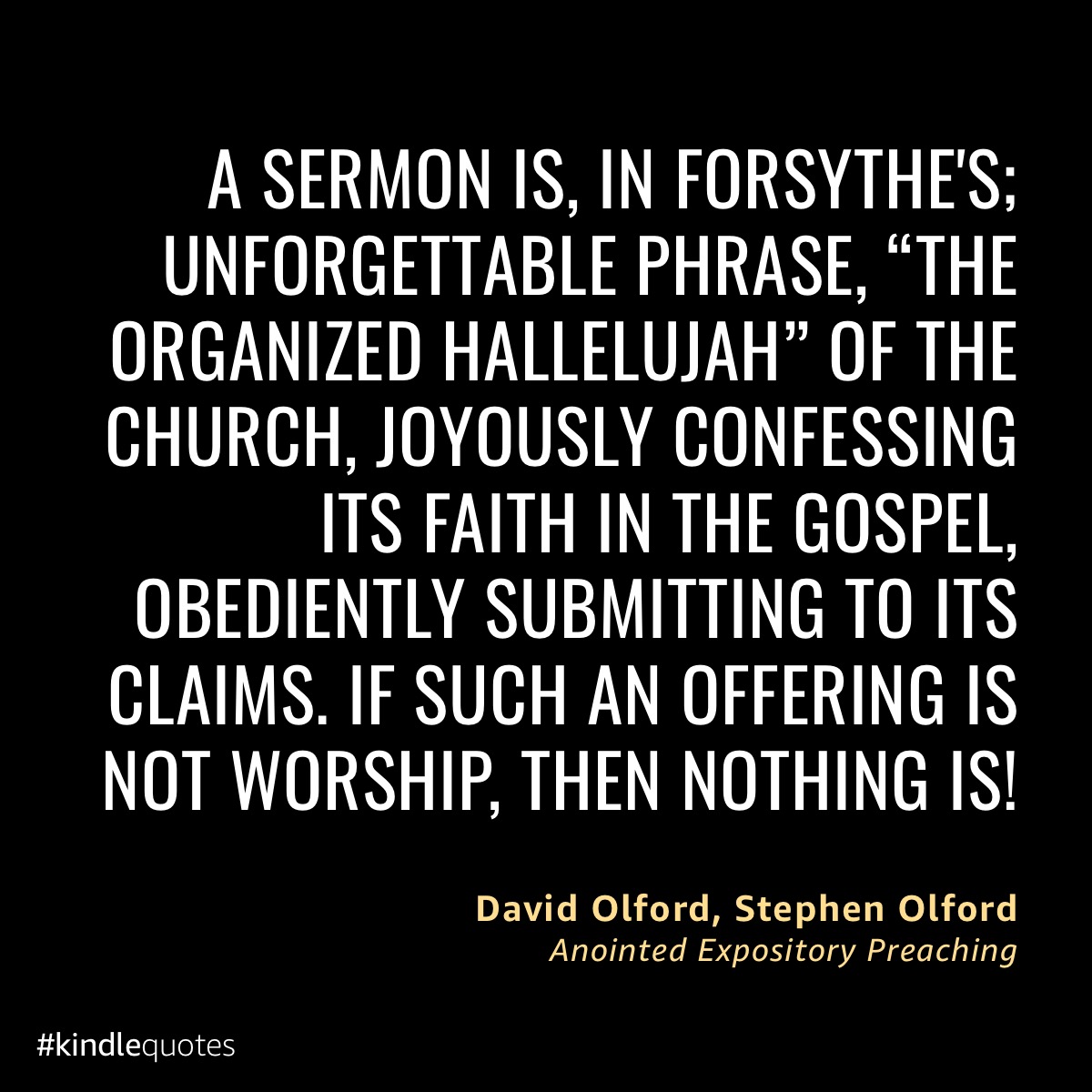
These thoughts were inspired from reading Appendix A in Stephen and David Olford’s book, “Anointed Expository Preaching.”  For a fuller understanding, I commend it to you. 

Saturday, March 21, 2020

SOCIAL DISTANCING


Read Psalm 1

Until the coronavirus pandemic, I had never heard the term “social distancing.”  The government is calling upon us to distance ourselves from contact with others who might infect us and spread the deadly virus.

While the term may be new, the concept is not. The Psalmist is warning us about an even deadlier virus called sin. If we are intimate with those who have given themselves over to it—embrace their counsel, enter their course, and enjoy their company—the contagion will destroy us.

There is a vaccine for this sin virus.  A daily dose of God’s Word has a power to immunize us. Let Scripture be your counselor, chart your course, and its truths your companions. Delight in the Word and digest its message. 

The word “meditate,” is to ruminate, as a sheep chews its cud extracting all the nutrition from the meal. So, we read the Word, study it, memorize it, meditate on it, and apply it—which is transforming.

To change the metaphor, we will be like trees, with roots downward for stability and fruit outward for productivity.  Our branches will be growing and our foliage will be showing—all to the glory of God.  We will not fear death and judgment for we have life, abundant life, here and hereafter—real happiness and prosperity. COVID-19 cannot change that. What if we die?  We can’t really!  All we would do is leave behind the only part of us that gives us a problem and enter the wonder of heaven!

But, not the wicked.  They are not trees. They are tumbleweeds. No root, no fruit, blown along by culture and circumstances—the prevailing winds of the moment. Worse of all, death is a constant fear and judgment a dreadful fate.  They often deny the existence of God because they do not want to consider the consequences of their choice. They did not listen and “shelter in place,” seeking refuge in Christ who alone can save us.

What choice will you make?

Friday, July 31, 2015

FOR THE YOUNG MAN IN MINISTRY (OLD-TIMERS MIGHT PROFIT TOO)


Now a certain Jew named Apollos, born at Alexandria, an eloquent man and mighty in the Scriptures, came to Ephesus.  (Acts 18:24)

If an arrow is aimed in the right direction, it is more likely to hit its target.  A good beginning as a young man in ministry does not insure a great ending, but it surely helps.  Apollos was one who was aimed the right way, and what a difference it made in him and those he served.  There are a few brief helps drawn from his story in Acts 18 which can guide the young preacher.

Develop your communication skills.  Apollos was “an eloquent man.”  While it might be a few exceptional preachers that are worthy of the description, “eloquent,” we must aim at least at being effective!  Pronouncing words clearly, the cadence of the voice, eye contact, and such may not come naturally to us, but we can work at it and improve.  The best sermon poorly delivered will be a waste of your time in preparation and the congregation’s in attendance.

Immerse yourself in Scripture and expound it.  Apollos was “mighty in the Scripture…instructed in the way of the Lord… he spoke and taught accurately….”  Believe it and apply it every day.  Feed your soul or you will not be able to feed your sheep.  This is more than preparing a sermon; it is preparing the servant—being strong in Scripture in our own personal life, so we can speak with authority in the pulpit.  The mandate is to, “Preach the Word!”  (2 Tim.4:2)   We are not to impose our opinions on the text.  That is pastoral malpractice!  Impressive communication can never substitute for inspired content.

Preach passionately.  Apollos was, “fervent in spirit.”  Why should our audience be excited about the sermon if we are not?  This isn’t just about volume, but we are not giving a classroom lecture on Bible history or theology.  We are enthusiastically proclaiming the truth that will transport one from darkness into light, and transform sinners into saints!  That is something to get stirred up about!

Preach courageously.  Apollos spoke, “boldly,” because he spoke Biblically. The temptation these days is to skirt the tough issues and make the message palatable to the culture.  Open the Book and open your mouth, speaking with clarity and conviction.

Listen and learn all your life.  A godly old couple, Aquila and Priscilla “took him aside and explained to him the way of God more accurately.”  Apollos knew a lot, but he did not know it all.  He was not an arrogant man, but a teachable preacher.  He knew how to talk, but he also knew how to listen.  You cannot teach someone who knows it all!  One thing a young preacher assuredly does not have is experience.  There are lessons learned in the laboratory of life that older, wiser lay people and elderly pastors can teach us.  Our peers are important, but our elders are indispensable.  The white-headed men in suits need to help the spikey-haired men in jeans!  The church needs both.

Exhort the saints and exalt the Savior.  Apollos “greatly helped those who had believed.”  Exhortation is giving people a pat on the back or a kick in the rear, depending on which is needed to move them along, with the discernment to know which is applicable.  Above all keep the focus on Jesus, “showing from the Scriptures that Jesus is the Christ.”  Apollos set that standard for us to emulate.  The ministry is about Jesus and not about us!


Sunday, July 19, 2015

THE SHEPHERD’S SUSTENANCE


Your words were found, and I ate them,
And Your word was to me the joy and rejoicing of my heart;
For I am called by Your name, O LORD God of hosts.  (Jeremiah 15:16)

The shepherd must be fed, if he is to feed the flock.  Leading the sheep into green pastures is demanding work.  It cannot be accomplished unless the shepherd is strong—and spiritually speaking, our sustenance is in the Scriptures.  Jeremiah consumed the Word of God and found it not only nourishing, but delightful.  He did not study in order to “get up a sermon,” but in order to get up with God!  If the man of God does not internalize the message, then he may be sure the congregation will not.  Should there be lack of passion in the pulpit, we may rest assured the sheep with have no delight in the message either.  Jeremiah was reminded in reading that he belonged to God—the God who revealed Himself as the Lord God of spiritual armies.  He would face many foes—the preacher of truth always does—but, the security of our relationship to the Almighty will strengthen God’s preacher to stand.  There are predators that would devour the flock.  Often wolves enter masquerading as sheep.  They are ferocious.  Yet, we are God’s and He will sustain us.  I pray that we have feasted on God’s Word this week, so that we will enter the pulpit with joy and send the sheep out full of truth and delight!  If we have failed, then let us repent and sin no more!

Sunday, May 3, 2015

TRUMPETING THE TRUTH

“Make two silver trumpets for yourself; you shall make them of hammered work; you shall use them for calling the congregation and for directing the movement of the camps." (Numbers 10:2)

The people of God are to be divinely directed.  Numbers is a book about walking with God.  The Hebrew title of the book is literally, "In the Wilderness."  This world is a wilderness.  We are pilgrims on a journey.  The wilderness is a place fraught with peril.  Our opportunity is limited, our responsibility is large, and our enemy is fierce--therefore, we must be led by the Lord, lest we become diverted by detours, delayed by dead-ends, or decimated by the Devil.  In the previous chapter, God had provided Israel guidance by His presence--the glory cloud--that moved out when they were to move and stopped where they were to camp.  Now, we find they were directed by not only the sight of the cloud, but the sound of the clarion.  The cloud represents the presence of God in His Spirit who guides the believer today, and the trumpet symbolizes the precepts of God in Holy Scripture that guide us as well.

Paul uses this analogy when confronting the confusion in the Corinthian church, "For if the trumpet makes an uncertain sound, who will prepare for battle?  So likewise you, unless you utter by the tongue words easy to understand, how will it be known what is spoken?  For you will be speaking into the air."  (I Cor.14:8-9)  Communicating God's message must be done clearly.

There were three basic purposes of these trumpets.  This is most instructive to the church today.

They were sounded for WARNING (Num.10:1-8).  Think of them as an alarm going off.  When God directed them by the movement of the cloud, the priests were also to blow these silver trumpets to warn the people it was time to move or time to stop.  We are too easily distracted by the world or dulled by slumber and so we may miss God's leading without someone putting the trumpet of truth to their lips and waking us up.  The teacher and preacher seek to do this each Sunday morning--to wake us up and move us out!  God has places for the church to go.

The silver trumpets were for WARRING (Num.10:9).  The people of God are not sightseers on a walk, but soldiers in a war!  The church is God's army.  On Sunday morning, we assemble at headquarters to receive our marching orders.  The preacher puts the trumpet of truth to his lips and conveys the battle plan.  We are equipped for the spiritual conflict awaiting us on Monday by hearing the truth on Sunday.  There is the "fog of war," and we cannot fight effectively without clear communication from our Commander.  The Word of God is our powerful weapon too!

The trumpet blasts were also for WORSHIPPING (Num.10:10).  Israel was to be assembled for worship as the trumpets sounded.  The Word of God is central in our worship.  That is why you find the pulpit at the center of most sanctuaries.  Whether that truth is sounded in song or sermon,  we will not have worship apart from the communication of the Word.

One of these days, the last trumpet will sound, and God's saints will be gathered home!  Until then may the truth be trumpeted loud and clear--for we will give an account (see 2 Tim.4:1-8).